
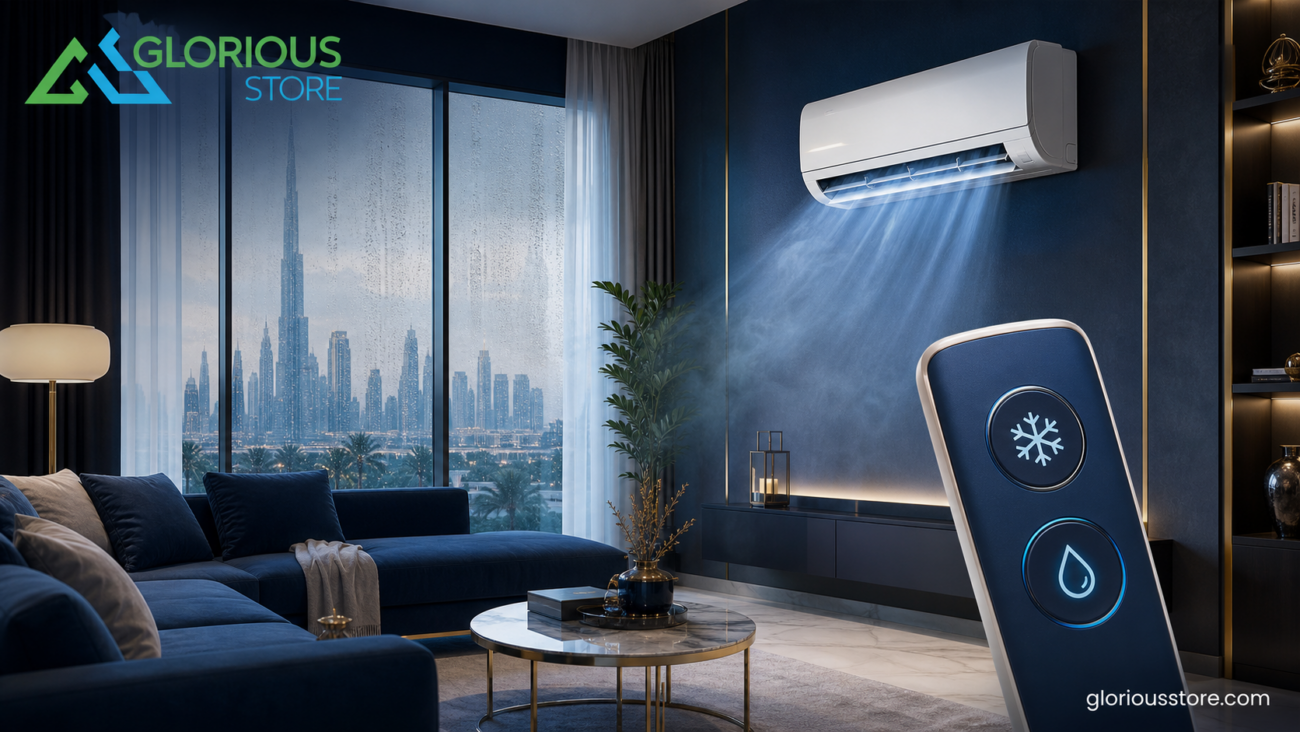
Dubai and the wider UAE can feel especially uncomfortable when high summer temperatures arrive with humid coastal air. Your air conditioner may lower the room temperature, yet the space can still feel clammy. That is when many people notice the water-drop button on their remote and ask: should I use AC dry mode or cool mode?
The short answer is simple. Use Cool mode when the room is genuinely hot and needs sustained temperature reduction. Use Dry mode, if your model provides it, when the temperature is already close to comfortable but excess humidity is the main problem. Dry mode is not a stronger version of cooling, and it is not a substitute for the correct AC capacity, good maintenance, or a dedicated dehumidifier when moisture is persistent.
This guide explains AC dry mode vs cool mode for UAE homes, how each setting works, and how to avoid common mistakes during humid weather.
Why humidity matters in UAE air conditioning
The UAE’s National Centre of Meteorology tracks relative humidity alongside temperature, wind, pressure, and other weather conditions. Humidity often rises overnight and near the coast, even when afternoon readings fall. The result can be a room that feels warmer or stickier than the thermostat reading suggests.
Air conditioners handle two different loads:
- Sensible heat: the temperature you see on the thermostat.
- Latent heat: the moisture carried in the air.
The cooling coil can remove some moisture when water vapor condenses on its cold surface and drains away. However, temperature control and moisture removal do not always finish at the same time. The U.S. Department of Energy notes that a cooling system may satisfy the temperature setting while moisture remains, leaving occupants feeling cold and clammy.
That distinction is the key to choosing between Cool and Dry modes.
What does Cool mode do?
Cool mode is the standard snowflake setting. The air conditioner runs its refrigeration cycle to move heat from indoors to outdoors, aiming to reach the temperature selected on the remote. The compressor and fan respond according to the model’s control system.
Choose Cool mode when:
- The room is clearly hotter than your chosen temperature.
- Direct sun, cooking, people, or electronics are adding significant heat.
- You have just returned to a warm home.
- You need dependable cooling for an extended period.
- Outdoor conditions are both very hot and humid.
Cool mode also removes moisture while the coil is cold and the system is running, but temperature is its main control target. An inverter air conditioner can adjust output instead of repeatedly operating only at full power, which may support steadier comfort when the unit is correctly sized and installed.
What does Dry mode do?
Dry mode is usually shown with a water-drop symbol. On models that include it, the system changes compressor and fan behavior to favor moisture removal while limiting excessive temperature reduction. The exact control sequence varies by manufacturer and model; there is no single universal Dry-mode algorithm.

Dry mode can be useful when:
- The room temperature is already near comfortable.
- Indoor air feels sticky after a humid night or foggy morning.
- Windows show light condensation.
- Laundry or normal household activity has temporarily increased indoor moisture.
- You want modest dehumidification without making the room much colder.
Dry mode may use a lower fan speed or cycle the compressor differently. It should not be treated as a guaranteed energy-saving button. Performance depends on equipment design, room load, outdoor conditions, and the control logic programmed into the unit.
AC Dry mode vs Cool mode: the practical difference
| Situation | Better first choice | Why |
|---|---|---|
| Room is hot and uncomfortable | Cool mode | Temperature reduction is the main need. |
| Room is comfortable but feels clammy | Dry mode, if available | Moisture is the main concern. |
| Strong afternoon sun is heating the room | Cool mode | The AC must handle a large sensible-heat load. |
| Humid early morning with mild indoor temperature | Dry mode, if available | May reduce moisture without aggressive cooling. |
| Persistent dampness or visible mold | Professional inspection | A mode change alone may not address the cause. |
| AC cannot reach the set temperature | Cool mode plus troubleshooting | Check sizing, filters, airflow, refrigerant, and installation. |
Dry mode is best viewed as a situational comfort setting. Cool mode remains the normal choice for the UAE’s hottest periods.
Can Dry mode save electricity?
It can use less electricity in some mild, humid conditions because it may run the compressor or fan differently. But it can also be the wrong setting during intense heat, causing discomfort and encouraging the user to run the system longer.
The responsible answer is that there is no universal percentage saving. The U.S. Department of Energy’s field research shows that dehumidification performance depends heavily on airflow, runtime, equipment controls, and the cooling load. Some Dry-mode strategies perform better during low-load periods, while standard cooling can remove more moisture during warmer conditions.
Instead of assuming Dry mode is always cheaper, select the mode that matches the actual problem. Keep windows closed, maintain the filter, reduce unnecessary heat gain, and choose a sensible temperature. The previously published Glorious Store guide to the best AC temperature for UAE summer explains why a moderate setting such as 24°C is often a practical starting point, subject to personal comfort and building conditions.
What if your AC remote has no Dry button?
Not every split air conditioner includes a user-selectable Dry mode. Check the product manual and the symbols on the original remote. Do not assume that an automatic, fan, sleep, or eco setting performs the same function.
If Dry mode is unavailable, Cool mode can still remove moisture while cooling. Use a moderate temperature, keep the fan on Auto when appropriate for the model, and avoid continuous fan-only circulation after cooling if it makes the room feel clammy. In persistently humid rooms, a separate dehumidifier or an HVAC assessment may be more suitable.
Never use an unknown universal remote command or unofficial firmware simply to unlock a feature the equipment may not support.
How to use Dry mode safely and effectively
- Close external doors and windows so humid air is not continually entering.
- Confirm that the room is not excessively hot. If it is, begin with Cool mode.
- Select the water-drop symbol only if the manual identifies it as Dry or dehumidification mode.
- Allow the system time to operate and reassess comfort rather than repeatedly changing settings.
- Return to Cool mode if the temperature rises or the room remains uncomfortable.
- Stop and arrange service if water leaks indoors, the drain appears blocked, or the unit produces unusual sounds or odors.
Do not rely on Dry mode for structural moisture, plumbing leaks, wet building materials, or mold. Those problems require the cause to be identified and corrected.
Improve humidity control before lowering the thermostat

Clean the indoor filter
A dirty filter restricts airflow and can reduce comfort. Follow the manufacturer’s cleaning instructions and reinstall the filter only when it is fully dry. If airflow remains weak after cleaning, arrange professional service.
Keep the condensate drain clear
Moisture removed from the air must leave through the drain. Indoor dripping, staining, or persistent musty odors can indicate a drainage or maintenance problem. Turn the system off if water is reaching electrical components and contact a qualified technician.
Reduce humid air leakage
Check that windows and balcony doors close properly. Repeatedly opening doors can introduce warm, moist outdoor air faster than the AC can handle it.
Protect airflow around both units
Do not block the indoor air inlet or outlet with curtains or furniture. The outdoor condenser also needs unobstructed ventilation. Shading can be helpful only when it does not trap hot discharge air or interfere with servicing.
Confirm the AC is correctly sized
An oversized fixed-capacity system may cool the room quickly and stop before removing enough moisture. An undersized unit may run continuously without reaching the desired temperature. Capacity selection should consider room area, ceiling height, insulation, windows, sun exposure, occupancy, and heat-producing equipment—not floor area alone.
Current StarSat inverter AC options at Glorious Store
Glorious Store currently lists two wall-mounted StarSat inverter air conditioners:
- StarSat 12000 Btu/h Inverter Air Conditioner — 10 units were shown in stock during this review. The listing describes cooling and heating, inverter operation, automatic climate control, and quiet operation.
- StarSat 9000 Btu/h Inverter Air Conditioner — a smaller current option listed in the StarSat air-conditioner category.
The live product pages do not currently state that either model has a Dry-mode button, so verify the supplied remote and manual before purchasing specifically for that feature. For normal UAE cooling, choose capacity through a qualified installer and review the current stock, warranty, installation requirements, and electrical specifications before ordering.
When to call an AC technician
Professional help is appropriate when:
- The unit runs but does not cool the room.
- Humidity remains unusually high despite normal operation.
- Water leaks from the indoor unit.
- Ice forms on the coil or pipework.
- Airflow is weak after filter cleaning.
- The system repeatedly trips a breaker.
- There is a burning smell, persistent musty odor, or unusual noise.
Do not open refrigerant lines or electrical panels yourself. Refrigerant, drainage, and electrical work should be handled by qualified technicians.
Final recommendation
For most hot UAE afternoons, use Cool mode. When the room is already near a comfortable temperature but feels humid, try Dry mode if the manufacturer confirms that your AC supports it. Avoid treating Dry mode as a universal energy-saving feature or a solution for an incorrectly sized or poorly maintained system.
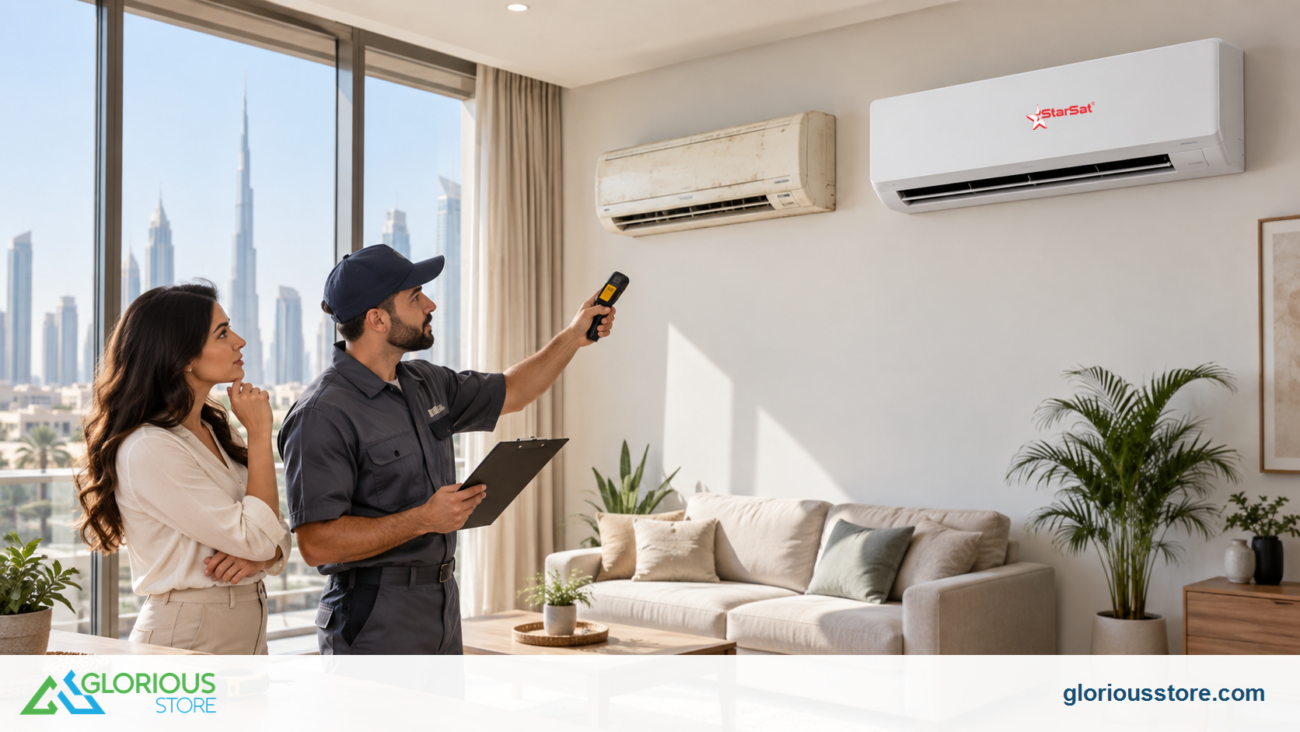
If you are replacing an older unit, compare the current StarSat inverter air conditioners and arrange professional capacity assessment and installation. The right equipment, a clean system, controlled air leakage, and sensible settings matter more than any single remote-control button.
Frequently asked questions
Is Dry mode better than Cool mode in Dubai?
Dry mode can be more comfortable during mild but humid conditions. Cool mode is usually the better choice during intense daytime heat because it prioritizes temperature reduction.
Can I leave my AC on Dry mode all night?
Follow the model’s manual and monitor comfort. Dry mode is not intended to replace normal cooling in every condition. If the room becomes warm, too cool, or remains clammy, use the appropriate cooling setting or investigate the moisture source.
What symbol means Dry mode on an AC remote?
It is commonly a water droplet, but symbols vary. Confirm it in the manufacturer’s manual rather than guessing.
Does Dry mode remove mold?
No. Lower humidity may make conditions less favorable for growth, but existing mold and the moisture source require appropriate inspection and remediation.
Does an inverter AC control humidity better?
Variable-capacity operation can support longer, steadier cycles, but humidity performance depends on sizing, airflow, controls, climate, and installation. “Inverter” alone is not a guarantee.
Should I use Fan mode to reduce humidity?
Fan-only mode does not actively cool the coil or remove moisture. In some situations, continuous airflow across a wet coil may return moisture to the room. Follow the manufacturer’s recommended settings.



Leave a comment