
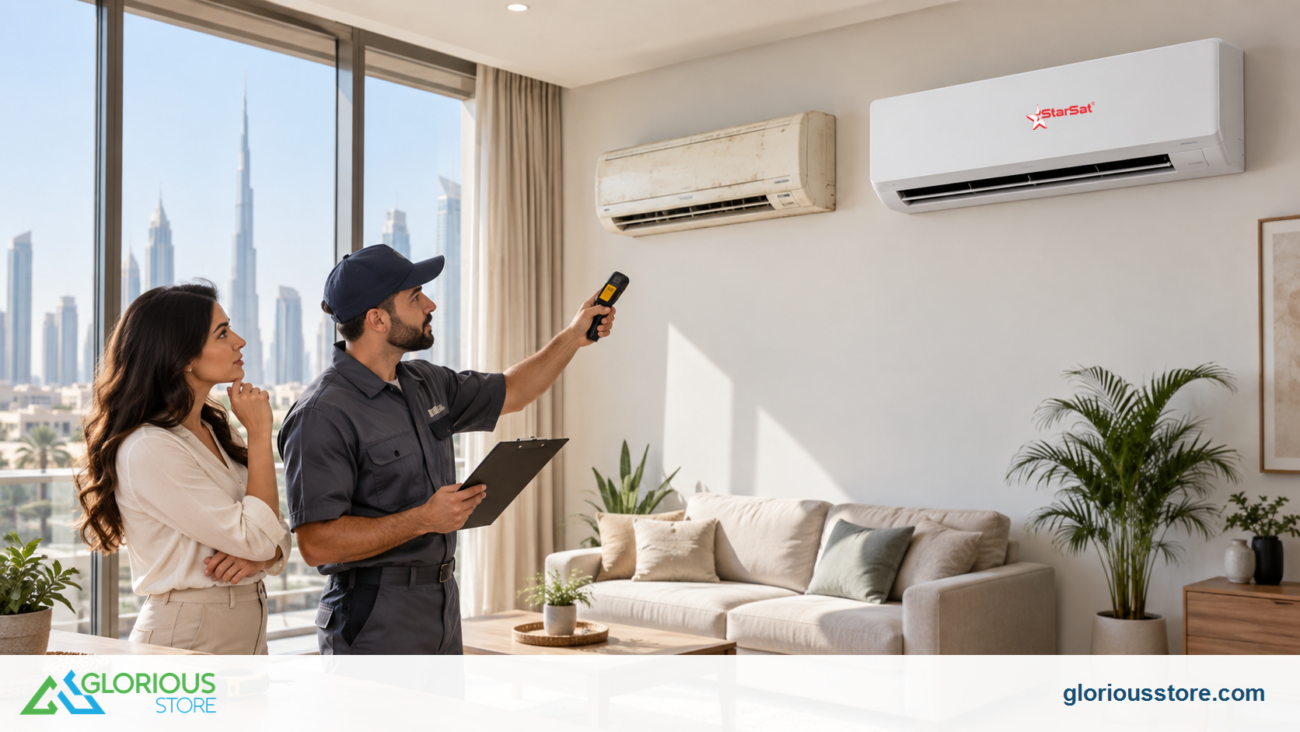
An air conditioner can be old without being finished, and a newer system can perform badly because of a correctable installation or maintenance problem. The sensible answer to when to replace AC UAE equipment is therefore not a single birthday or one expensive electricity bill. It is a decision based on age, service history, comfort, measured performance, repair risk and whether a replacement can be sized and installed properly.
Dubai Electricity and Water Authority currently describes ten years as the optimal lifetime of an AC and advises owners of older systems to consider efficient replacements. Treat that as a prompt for professional evaluation, not an automatic expiry date. A well-maintained ten-year-old unit may justify a repair; a younger unit with repeated major faults, poor capacity matching or unavailable parts may not.
This guide gives UAE homeowners a calm, evidence-based way to compare those paths without guessing about refrigerant, efficiency or room size.
Why This Decision Is Timely in 2026
DEWA updated its consumer cooling guidance on May 16, 2026. Alongside the ten-year reference, it recommends a 24°C-or-higher thermostat setting, regular filter cleaning, reduced solar heat gain and better air sealing. Those measures matter because they can reveal whether the equipment itself is failing or the room is simply gaining too much heat.
In a July 7, 2026 summer travel advisory, DEWA again encouraged regular AC-filter cleaning, closed doors and windows, periodic maintenance by specialized technicians, and consumption monitoring. The return from summer travel is a useful time to review bills and service records before the next heavy-cooling season forces an emergency decision.
The 10-Year Rule Is a Checkpoint, Not a Verdict
Age matters because compressors, fan motors, electronic controls, coils, insulation and seals accumulate operating hours in a demanding climate. Yet calendar age cannot tell you whether a specific repair will last or whether a replacement will save enough to justify its full installed cost.
Use ten years as the point to collect better evidence:
- Find the installation date, exact model and serial number.
- Compare like-for-like electricity use and list recent repairs, especially repeat visits for the same symptom.
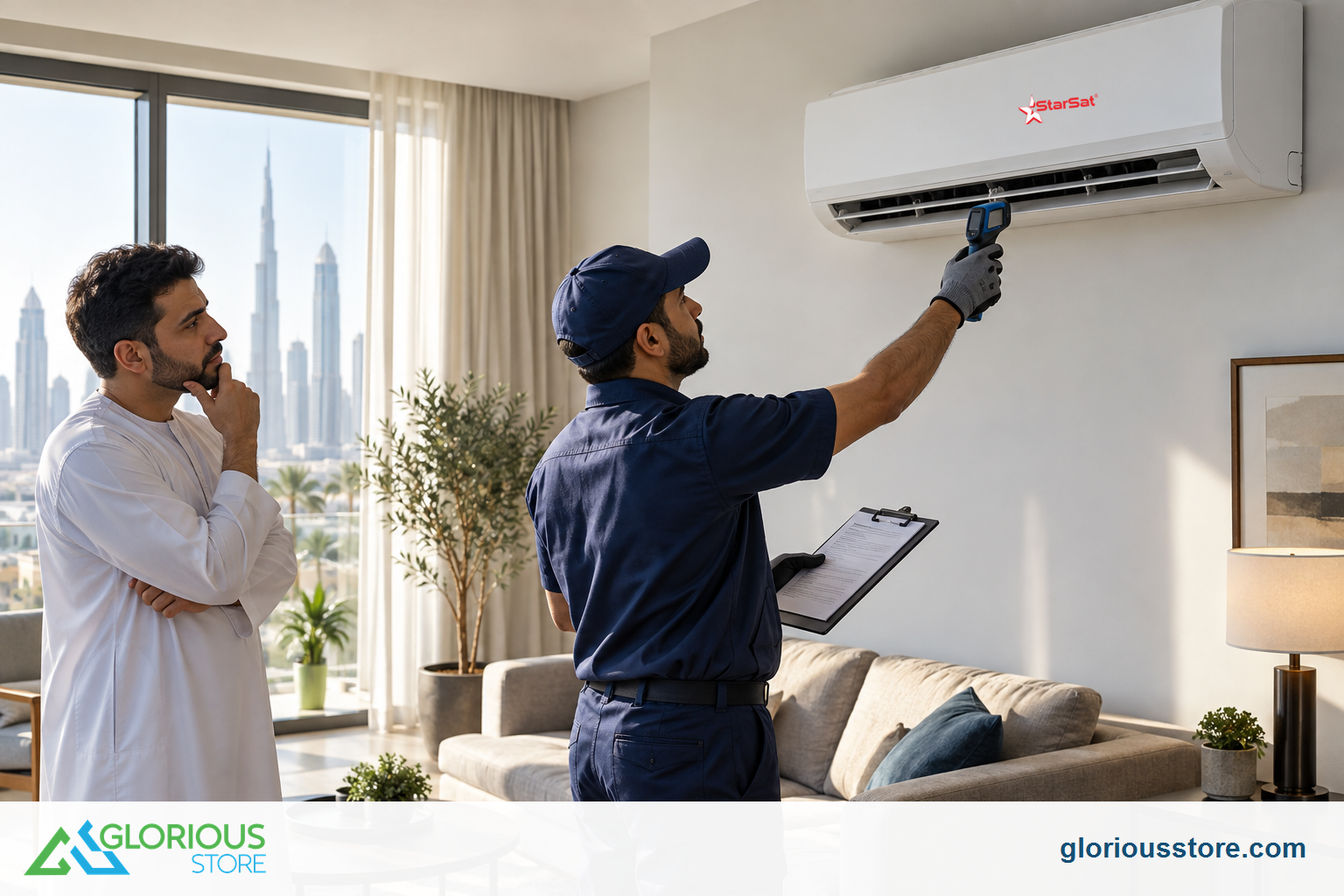
- Ask a qualified technician for the diagnosed fault, measured operating results and written options.
- Price the complete replacement scope, including installation, electrical work, pipework, drainage, removal and warranty—not only the indoor unit.
ENERGY STAR’s general replacement checklist similarly flags equipment over ten years old, frequent repairs, rising bills and rooms that remain too hot or cold. Its certification and savings figures are US-specific, so UAE buyers should use local labels, regulations and quotations. The diagnostic signs are still useful questions for a contractor.
Seven Signs That Justify a Replacement Assessment
1. Repairs are becoming frequent
One isolated fault does not prove the whole system is finished. A pattern of breakdowns, especially repeat failures shortly after service, changes the calculation. Ask which component failed, what caused it and what remaining risks the technician sees.
2. Cooling has declined after basic checks
Confirm Cool mode, a reasonable set point, clean user-serviceable filters, unobstructed indoor airflow, closed windows and enough runtime. If performance remains weak, arrange diagnosis. Do not assume that “low gas” is the answer; airflow, controls, coils, electrical faults, capacity or installation can produce similar symptoms. The separate AC refrigerant guide explains why repeated top-ups without leak diagnosis are a warning sign.
3. Bills rise without a clear lifestyle change
Compare the same property, occupancy, thermostat habits and season. Tariffs, weather, added appliances and longer hours can change consumption. A rising bill is a reason to investigate, not proof that replacing one AC will deliver a fixed percentage saving.
4. Some rooms never become comfortable
Hot spots may come from solar gain, air leakage, blocked airflow or the wrong capacity rather than old equipment. Oversizing can also be harmful because short cycling may reduce comfort and shorten equipment life. ENERGY STAR’s quality-installation guidance recommends sizing from the actual home instead of a rule of thumb.
5. Noise, vibration, water or odors keep returning
Stop using the unit if there is an electrical smell, smoke, sparking or a safety concern, and arrange qualified service. For less urgent noise, vibration or water, document when it occurs. Repeated symptoms after proper repair make replacement more reasonable.
6. Essential parts or technical information are unavailable
Ask whether the exact part is genuine or approved, how long it is expected to remain available, and whether the manufacturer supports the model revision. Do not approve an improvised refrigerant conversion or mismatched component based on a verbal promise.
7. The system no longer matches the room or household
Renovation, new glazing, changed occupancy, added electronics or a divided room can alter the cooling load. Replacing like-for-like capacity without a fresh assessment can repeat the original mistake.
Repair First or Replace? Use the Whole Picture
| Situation | Repair may be sensible | Replacement becomes stronger |
|---|---|---|
| Age | Unit is younger or has a clean service history | Around or beyond the ten-year checkpoint plus other warning signs |
| Fault | Isolated, clearly diagnosed and repairable | Major or recurring failure with uncertain remaining life |
| Comfort | Problem traces to maintenance, controls or air sealing | Correctable building issues are addressed but comfort remains poor |
| Cost | Written repair is limited and carries a useful warranty | Repairs are accumulating or approach a meaningful share of full installed replacement cost |
| Support | Correct parts and model information are available | Parts, approved refrigerant service or technical support are unreliable |
| Fit | Existing capacity and installation are verified | Load, layout or electrical requirements have changed |
Avoid universal rules such as “replace when repair costs half the price.” Quotes differ, and a low equipment-only price can omit installation work. Compare written scopes, warranty, expected remaining risk and disruption.
What to Ask During a Professional Assessment
A useful report should identify evidence, not only recommend a purchase. Ask the contractor to record:
- Exact model, serial number, age and refrigerant shown on the data plate.
- Your complaint and the conditions under which it appears.
- Filter, coil, fan, drain, electrical and control findings that can be checked safely.
- Measured indoor airflow and temperature observations, interpreted for the exact model and current conditions.
- Leak-test findings when refrigerant loss is suspected; never request routine venting or blind refilling.
- The diagnosed failed component, repair warranty and realistic parts availability.
- A replacement heat-load calculation and explanation of the proposed capacity.
- Full installation scope, commissioning checks and who handles the old equipment.
If two expensive recommendations conflict, a second qualified opinion is often cheaper than replacing the wrong thing.
Plan the Replacement Before Choosing a Model
Recalculate capacity
Floor area alone is not enough. Sun exposure, glass, insulation, ceiling height, occupancy, equipment and air leakage affect the load. The existing capacity may be evidence, but it is not a calculation.
Separate inverter control from energy rating
An inverter compressor can vary output, but it does not prove a particular UAE efficiency grade. Check the exact retail unit’s local energy label and model data. The inverter AC and UAE energy-rating guide explains why these are separate checks.
Confirm the complete installation
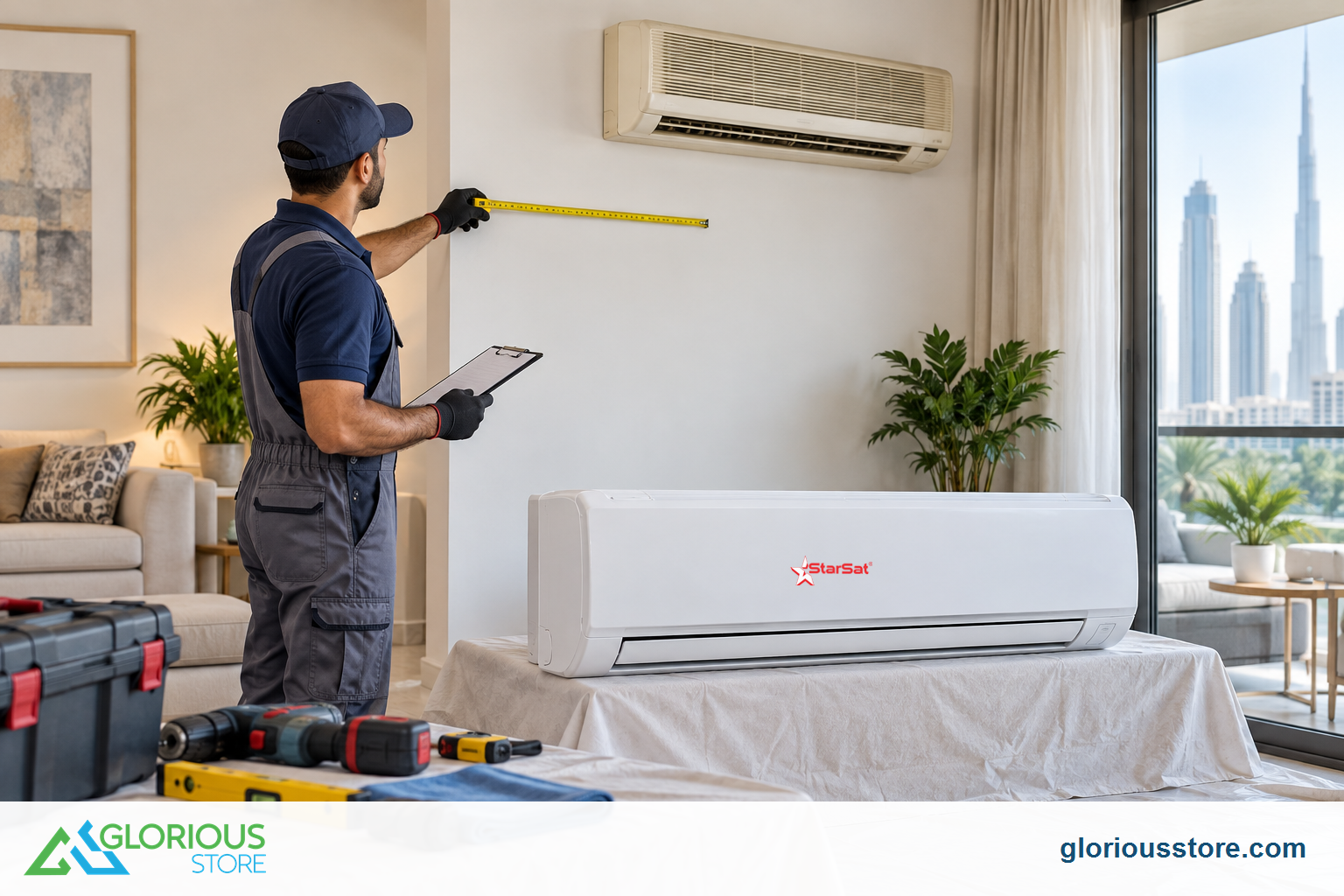
Verify indoor and outdoor dimensions, clearances, electrical supply, cable and breaker requirements, pipe sizes and length limits, drain route, brackets, vibration control, included materials and warranty responsibilities. Good equipment can disappoint when airflow, refrigerant charge or commissioning is wrong.
Current StarSat AC Availability at Glorious Store
Stock was checked on September 14, 2026. Two StarSat inverter split ACs showed 10 in stock and an Add to Cart button:
| Current model | Published listing details | What to confirm |
|---|---|---|
| StarSat 9000 Btu/h Inverter Air Conditioner | 9,000 Btu/h cooling/heating; 785 × 335 × 240 mm indoor unit; 745 × 335 × 550 mm outdoor unit | Heat-load fit for the intended room and the complete installation scope |
| StarSat 12000 Btu/h Inverter Air Conditioner | 12,000 Btu/h cooling/heating; 865 × 335 × 240 mm indoor unit; 810 × 335 × 595 mm outdoor unit; auto climate control and quiet operation listed | Whether the larger capacity matches the assessed load rather than floor area alone |
Neither live listing publishes the UAE energy-label values, refrigerant type, electrical requirements, maximum line length, included installation materials or warranty scope; confirm these before ordering. The 18,000 and 24,000 Btu/h pages were out of stock, so they are not current recommendations. Recheck the live air-conditioner collection because availability can change.
Remove the Old AC Responsibly
A split system should remain intact until qualified personnel isolate it and recover refrigerant using appropriate equipment. Do not cut lines, release gas or leave the unit at an informal scrap point. Dubai Municipality publishes information on licensed waste-processing and recycling premises, including refrigerant-related facilities. Ask the installer or building management to document the local removal route that applies to your property.
Frequently Asked Questions
Should I replace every AC after ten years?
No. DEWA’s ten-year reference is a useful evaluation point. Condition, repair history, performance, support and the quality of the proposed replacement all matter.
Is a high electricity bill enough reason to replace an AC?
No. Compare similar months and account for weather, occupancy, thermostat settings and other loads. Arrange diagnosis before assigning the increase to one unit.
Should I repair an old compressor or replace the system?
Ask for the exact failure diagnosis, complete repair scope, warranty, parts availability and remaining risks. Compare that with a correctly sized, fully installed replacement quote. There is no responsible universal answer without those facts.
Will a new inverter AC automatically reduce my bill?
No guaranteed percentage applies. Capacity, energy-label performance, installation, controls, building heat gain and behavior all affect consumption.
Can I choose between the current 9000 and 12000 BTU/h models by room size alone?
No. Rooms with similar floor area can have different cooling loads. Confirm heat gain, dimensions, power, pipework, drainage, warranty and installation scope for the exact room first.
Make the Decision With Evidence
Start with age and service history, then add measurements, comfort patterns, repair risk and a proper load assessment. If replacement is justified, compare the complete installed result rather than a headline price. Review the two current listings and contact Glorious Store with the room details and exact model questions. Recheck stock and specifications immediately before purchase.
Sources
- DEWA Cooling, last updated May 16, 2026.
- DEWA pre-travel utility checks, July 7, 2026.
- ENERGY STAR: When is it time to replace?, accessed September 14, 2026.
- ENERGY STAR HVAC Quality Installation, accessed September 14, 2026.
- Dubai Municipality licensed waste-processing and recycling premises, January 2025.





Leave a comment