
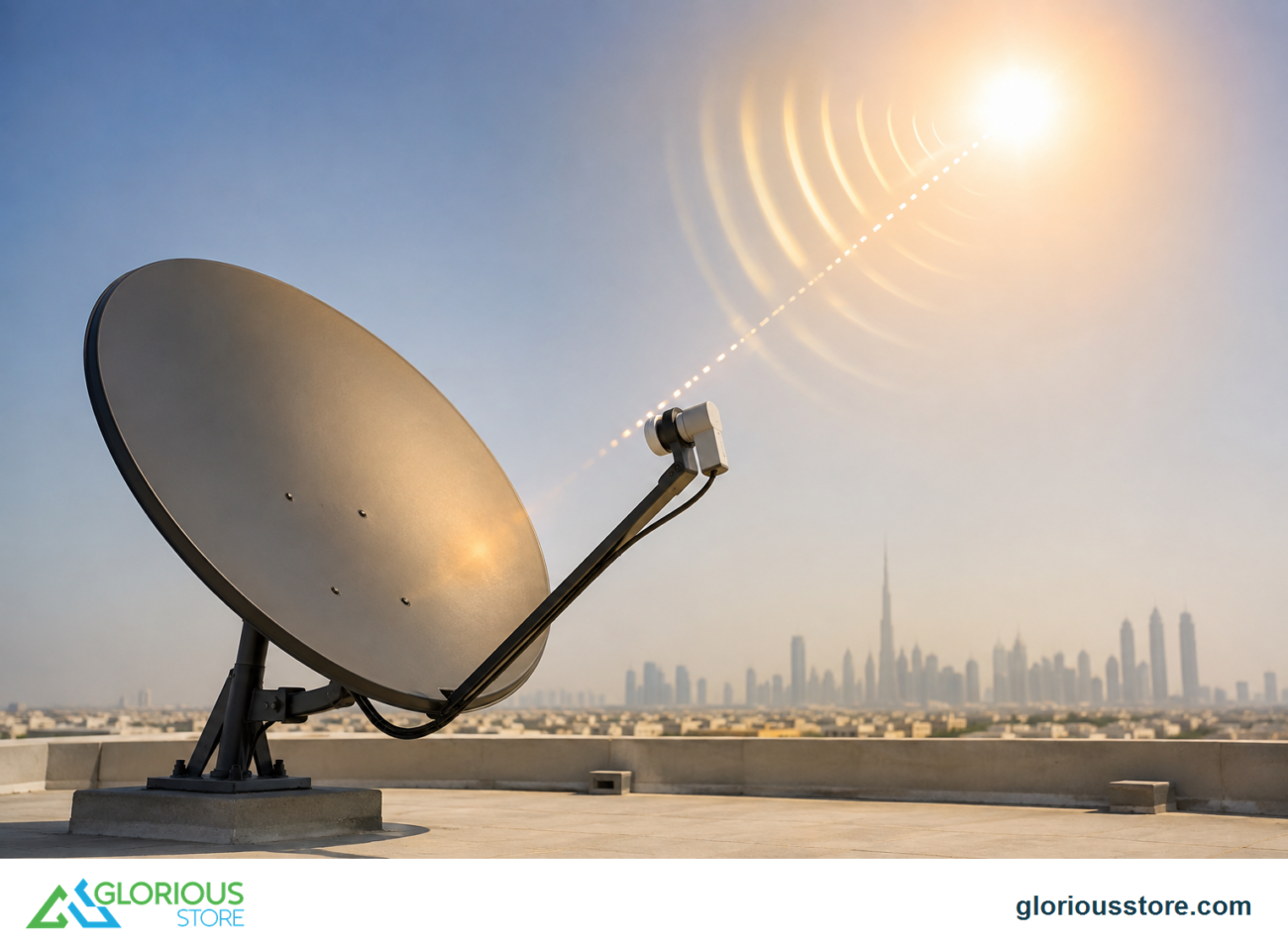
A satellite sun outage in the UAE can look like a hardware fault: the picture pixelates, audio breaks up, or the receiver briefly loses lock. The clue is repetition. If the interruption happens at almost the same time on several clear days and service returns without any adjustment, the Sun may be passing behind the satellite from your dish’s point of view.
This is a predictable radio-frequency effect near equinox season, not sunlight “burning” the dish and not evidence that every receiver or LNB needs replacement. This guide explains the pattern, what to record, what to leave alone, and how to decide whether ordinary troubleshooting is still needed after the short event has passed.
Why this matters in September 2026
NASA lists the September 2026 equinox at 00:05 UTC on September 23. The calendar date is useful context, but it is not a household outage timetable. The exact days and clock times of solar interference vary with the receiving location, the satellite’s orbital position, the antenna beamwidth, and other system details.
Intelsat’s technical sun-interference background explains that, for several minutes per day over several days during the February/March and September/October equinox seasons, the Sun can appear directly behind a geostationary satellite in an earth station’s line of sight. Solar radio noise can then degrade service or temporarily overwhelm the wanted signal.
For UAE viewers, the practical takeaway is simple: a brief, repeatable daytime interruption around this season can be normal. Do not use the equinox itself to predict a precise minute for a particular dish. Your broadcaster, satellite operator, or qualified installer may have a location-specific forecast.
What a satellite sun outage actually is
A geostationary communications satellite appears fixed in the sky because it orbits above the equator at the same angular rate that Earth rotates. A receiving dish is aimed at that narrow position. Around an equinox, the Sun’s apparent path can line up behind the satellite as viewed from the receiving antenna.
The dish does not distinguish between the wanted downlink and all other radio-frequency energy arriving through its beam. When the bright radio noise from the Sun enters the same beam, the signal-to-noise ratio falls. A digital receiver may show falling quality, picture breakup, freezing, audio gaps, or a temporary “no signal” message. When the alignment passes, normal reception can return by itself.

This is different from an eclipse of the satellite, a power cut, rain fade, or a permanently misaligned dish. It also does not mean that a stronger receiver can decode a signal that is temporarily buried in solar noise. Equipment condition still matters to the system’s normal margin, but replacing parts during a predictable short event is not a responsible first response.
Recognize the pattern before touching the dish
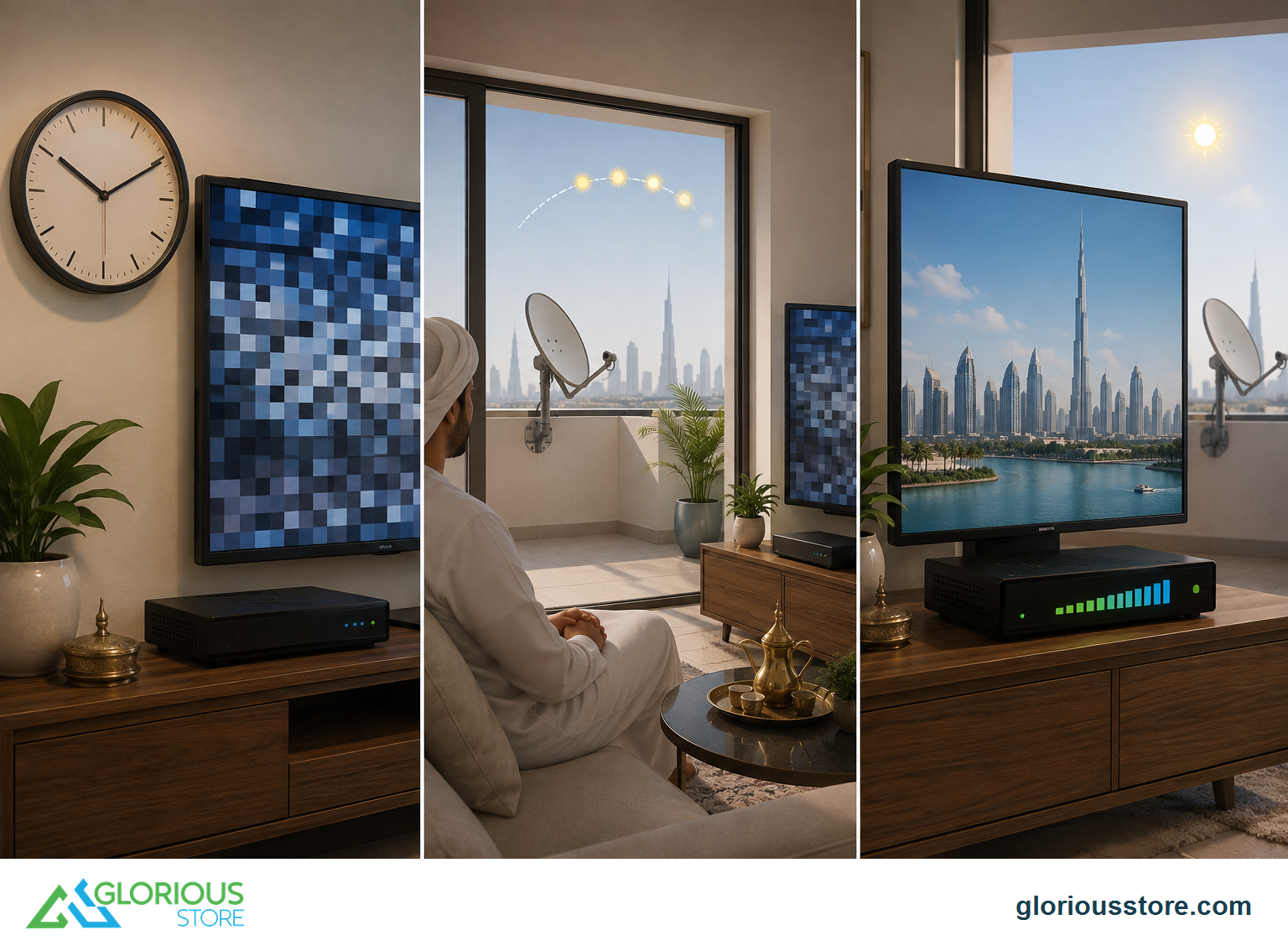
One interruption is not enough to diagnose a sun outage. Record the following details over several days:
- Start and end time: note the minute when breakup begins and when normal service returns.
- Duration: a short event that follows a similar daily pattern is more suggestive than an all-day fault.
- Weather: write down whether the sky is clear, dusty, rainy, or windy.
- Affected services: test a few authorized channels on the same satellite and, if your installation uses more than one satellite, compare them.
- Signal readings: photograph the receiver’s strength and quality screens before, during, and after the event without changing settings.
Signal strength and signal quality are not interchangeable, and their scales are not standardized across receivers. A stable strength reading with a sharp temporary quality drop can still be useful evidence. Compare readings from the same receiver and channel rather than treating a percentage as a universal engineering measurement.
What to do during the brief interruption
First, wait safely. Do not climb onto a roof, loosen a mount, rotate the LNB, rescan channels, or factory-reset the receiver while the event is in progress. Those actions can create a lasting fault after the temporary interference ends. Keep people away from exposed rooftops and electrical or RF connections unless a qualified technician is handling the work.
Check whether the picture returns on its own. If it does, preserve your notes and repeat the observation on the next clear day. The event time may shift slightly from day to day. If your provider publishes a sun-interference schedule, compare it with your location and satellite rather than assuming a schedule for another city applies in Dubai, Abu Dhabi, Sharjah, or elsewhere in the region.
When the problem probably needs troubleshooting
A sun outage should be brief and seasonal. Investigate ordinary faults if the loss lasts much longer, happens at random times, continues overnight, affects only one cable run, begins after wind or building work, or does not clear by itself. Persistent problems can involve loose connectors, damaged coaxial cable, moisture ingress, a failing LNB, incorrect DiSEqC settings, receiver configuration, or dish movement.
Start indoors with safe checks: confirm the television input, restart the receiver normally, inspect accessible cable connections, and compare several authorized channels. Do not repeatedly rescan, because an empty scan made during poor reception can remove a previously working channel list. Our broader satellite no-signal guide covers the general fault path; this article focuses only on the equinox-season pattern.
If the signal remains poor after the expected window, a qualified installer can measure the system under normal conditions, inspect weatherproofing, confirm the intended satellite and transponder, and fine-tune alignment. A measurement taken after service returns is more useful than adjusting blindly while solar noise is dominating the receive path.
Current Glorious Store equipment to review
Stock was checked on September 5, 2026 and can change. These products support diagnosis or a correctly planned installation; none can prevent the Sun from entering a dish beam during exact alignment.
StarSat SF-002 Satellite Finder
The StarSat SF-002 Satellite Finder showed 50 in stock with an Add to Cart control. The listing specifies DVB-S/S2 support, a 4.3-inch TFT LCD, spectrum and constellation functions, 950–2150 MHz input, a 5000 mAh Li-ion battery, RF input, USB 2.0, and an LED torch.
This is installer-oriented equipment for checking and aligning a satellite system under normal reception conditions. It does not forecast the exact sun-outage window and should not be used as a reason for an untrained person to access an unsafe roof. Confirm the current retail package, software, connectors, and suitability for the satellite and job before ordering. See the satellite finder collection for current alternatives.
StarSat SL-4004 quad-output LNB
The StarSat SL-4004 LNB showed 8 in stock with Add to Cart. Its page lists four independent outputs, 10.70–12.75 GHz input, 950–2150 MHz output, 9.75/10.60 GHz local oscillators, a stated 0.6 dB noise figure, and 60 dB gain.
Consider a quad-output LNB when the installation genuinely needs up to four independent receiver feeds and the rest of the system is compatible. It is not a splitter substitute for every topology, and “4K ready” does not make it immune to solar interference. Confirm cable runs, switching, power, dish fit, weather sealing, and required output count with an installer. Browse the current LNB range if a single, twin, quad, or other configuration is more appropriate.
StarSat SR-X41S DiSEqC switch
For a multi-LNB installation, the StarSat SR-X41S four-port DiSEqC switch showed 46 in stock with Add to Cart. The listing identifies a 4×1, DiSEqC 2.0 switch for selecting among multiple LNB inputs. It is relevant only when the receiver, switching plan, frequencies, power passing, connectors, and installation are compatible.
A switch cannot correct a sun outage. It can, however, be one item an installer checks if only one satellite path fails or if switching is unreliable after the temporary event. Do not replace a switch solely because all services on one satellite briefly break up at a repeatable equinox-season time.
A five-minute post-event check
- Confirm that normal reception returned without changing alignment or settings.
- Compare the same channels and receiver quality screen used during the interruption.
- Check another satellite path only if your installed system is designed for it.
- Save the date, start time, end time, weather, channel, satellite, and screenshots.
- Escalate to the provider or installer if the fault persists, expands, or becomes random.
This record prevents unnecessary purchases and gives a technician something specific to test. It also separates a predictable seasonal event from heat-related drift, rain fade, cable damage, or a marginal alignment that needs attention.
Frequently asked questions
How long does a satellite sun outage last?
Intelsat describes interference lasting several minutes per day for several days during equinox season. The exact duration and severity depend on the receiving antenna, frequency band, location, satellite, and system margin. Use an operator or installer forecast for your specific path.
Does a sun outage damage the LNB or receiver?
The normal effect is radio-frequency interference that reduces the wanted signal-to-noise ratio; it is not proof of damaged hardware. If reception does not return or other symptoms remain, troubleshoot the installation separately.
Should I realign the dish when the picture breaks up?
Not during a short, repeatable suspected sun-outage window. Moving a correctly aligned dish can create a permanent problem. Record the event and wait for reception to return. Ask a qualified installer to test persistent weakness under normal conditions.
Can a larger dish or new LNB prevent solar interference?
No responsible universal guarantee can be made. Antenna characteristics and system margin affect severity, but solar radio noise can still overwhelm reception during alignment. Choose equipment for the complete installation, not as a promised cure for the Sun.
Why does only one satellite seem affected?
Different orbital positions line up with the Sun at different local times and possibly on different days. In a multi-satellite system, compare paths carefully and also rule out an LNB, cable, connector, or DiSEqC issue if a problem persists outside a short seasonal window.
Record first, then diagnose
A short signal loss at almost the same daytime minute across several clear days near the September equinox can be a satellite sun outage in the UAE. Wait, document the pattern, and avoid unnecessary adjustments. If reception does not recover normally, use the ordinary troubleshooting path and qualified measurements.
Contact Glorious Store with your receiver model, satellite, city, signal readings, event times, and installation layout to discuss currently available diagnostic or replacement equipment. Recheck stock and essential compatibility before ordering.



Leave a comment