
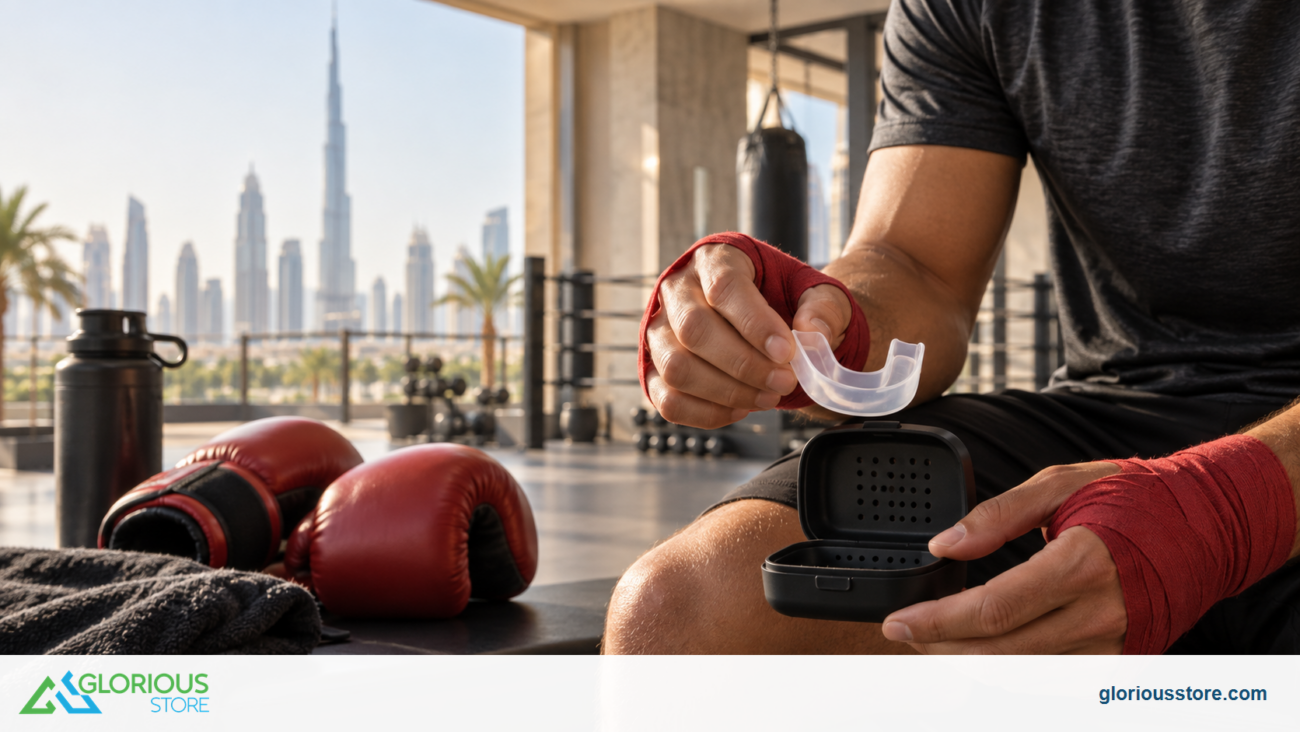
Sports Mouthguard UAE: Fit, Care & 2026 Buying Guide
A sports mouthguard is easy to overlook until training becomes faster, contact gets heavier, or a loose fit becomes distracting. For boxing, martial arts and other activities with a realistic risk of impact to the mouth, the useful question is not simply “Do I own a guard?” It is “Does this guard fit, stay in place, allow practical breathing and remain in good condition?”
That question is timely in the UAE. The tenth Dubai Fitness Challenge runs from 31 October to 29 November 2026, inviting residents and visitors to complete 30 minutes of activity for 30 days. Not every Challenge activity needs a mouthguard. A walk, yoga session or normal gym circuit usually does not. But people using the season to start boxing, combat-sport drills or another higher-risk activity should review protective equipment before the first hard session, not after it.
This sports mouthguard UAE guide explains the main types, the fit checks that matter, how to care for one in a hot climate, and how two current Glorious Fitness options fit into a sensible buying decision. It is general education, not individual dental advice. If you have braces, bridgework, a recent dental procedure, a jaw problem or uncertainty about fit, ask a dentist or orthodontist before training.
Why fit matters more than marketing language
The American Dental Association recommends a properly fitted mouthguard for sports and recreational activities with meaningful risk of dental or facial injury. The FDI World Dental Federation likewise identifies a mouthguard as essential equipment for contact and collision sports where oral injury is expected.
“Properly fitted” is the important phrase. A guard should sit securely over the intended dental arch without constant clenching, provide a resilient protective surface, feel reasonably comfortable and be practical to clean. A product description can tell you its design, colors and stated use; it cannot prove how it will fit your mouth.
Do not treat a mouthguard as permission to ignore coaching, rules, head protection or medical advice. It is one part of a wider safety system. It also should not be marketed as a guaranteed way to prevent every dental injury or concussion.
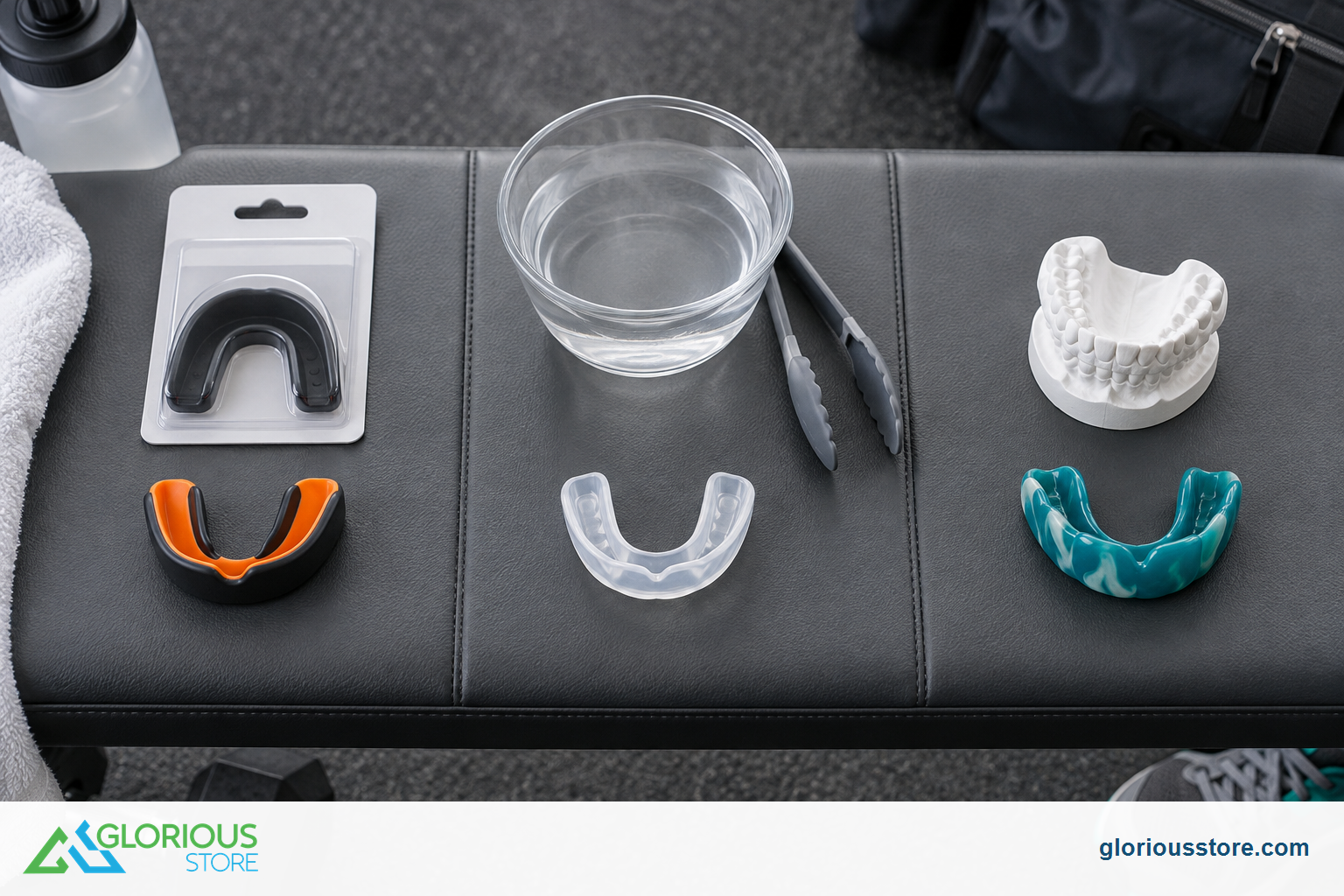
Three common mouthguard types
Custom-made guards
A dentist or dental laboratory makes a custom guard from an impression or scan of your mouth. This route normally offers the greatest scope to adapt the design to your teeth, bite, sport and orthodontic situation. It also costs more and requires a professional appointment.
Custom-made is worth discussing when a ready-made guard will not stay in place, when comfort affects consistent use, or when braces and dental work make self-selection uncertain. “Custom” should mean genuinely made for your mouth, not simply a retail guard available in several colors.
Mouth-formed or boil-and-bite guards
These guards soften in heated water and are shaped around the teeth. They can fit better than a basic pre-formed model when the molding is done correctly. Follow the manufacturer’s exact water temperature, timing, cooling and shaping instructions. A generic internet timing should not replace the instructions supplied with the product.
Too much heat can thin or distort the material. A shallow impression can leave the guard loose. If the device makes breathing unusually difficult, has sharp edges, rocks during movement or requires constant biting to stay up, stop and review the fit.
Stock or ready-made guards
Stock guards are pre-formed and generally cost less. Their main limitation is adaptation: the shape may not match the wearer closely, so retention and comfort can be weaker. A stock guard that falls out whenever the mouth opens is not a good practical fit, even if the size printed on the package appears correct.
A practical fit checklist before training
Run these checks at home and again during a light warm-up:
- Retention: the guard should remain seated when you open your mouth gently. You should not need to clamp down continuously.
- Coverage: it should cover the intended teeth without an edge pressing painfully into the gums.
- Breathing: normal breathing should remain practical for the intended effort.
- Speech: perfect speech is not the goal, but communication with a coach should be possible.
- Surface: look for splits, rough edges, thinning, bite-through areas or deformation.
- Comfort: pressure should feel even rather than concentrated on one tooth or sore area.
- Activity match: confirm that the design and your gym or competition rules suit the sport.
A new mouthguard may feel unfamiliar, but persistent pain, gagging, looseness or interference with breathing is not something to “push through.” Refitting may be possible only if the manufacturer permits it. Otherwise, choose a different size or design, or ask a dental professional.
Braces and changing teeth need extra care
Fixed braces change the space a guard must accommodate. Teeth can also move during orthodontic treatment, while children and teenagers can outgrow a previously acceptable fit. The ADA recommends involving a dentist or orthodontist when selecting protection around orthodontic appliances. Never assume a general retail guard is suitable for braces because it looks roomy.
Current Glorious Fitness options checked in the UAE
Both live listings below were checked on 26 September 2026. Each page displayed In Stock, selectable variants and a purchase control. Availability can change, and neither page publishes an exact unit count.
| Current option | What the listing establishes | Confirm before ordering |
|---|---|---|
| Glorious Fitness Mouth Guards | Product code MG; selectable colors; listed weight 0.03 kg; listed dimensions 6.3 × 6.3 × 2.7 cm | Exact material, fitting method, age/size range, braces suitability, included case and molding instructions |
| Glorious Double Layer Mouth Guards | Product code DL-MG; double-layer and boil-and-bite design stated; selectable color combinations; listed weight 0.03 kg; listed dimensions 6 × 6 × 2 cm | Exact material, size range, braces suitability, heat/molding steps, included case and sport-specific requirements |
The double-layer description does not by itself prove that the model is better for every person or activity. Layer count is only one design detail. Fit, retention, coverage, material quality, condition and consistent use all matter. The standard model’s page uses broad performance language but does not publish a named certification or complete fitting procedure; ask for those details if they affect your decision.
You can also browse the Glorious Fitness collection or the current sale page. Check the live variant before checkout rather than relying on an article’s dated stock snapshot.
How to clean and store a sports mouthguard
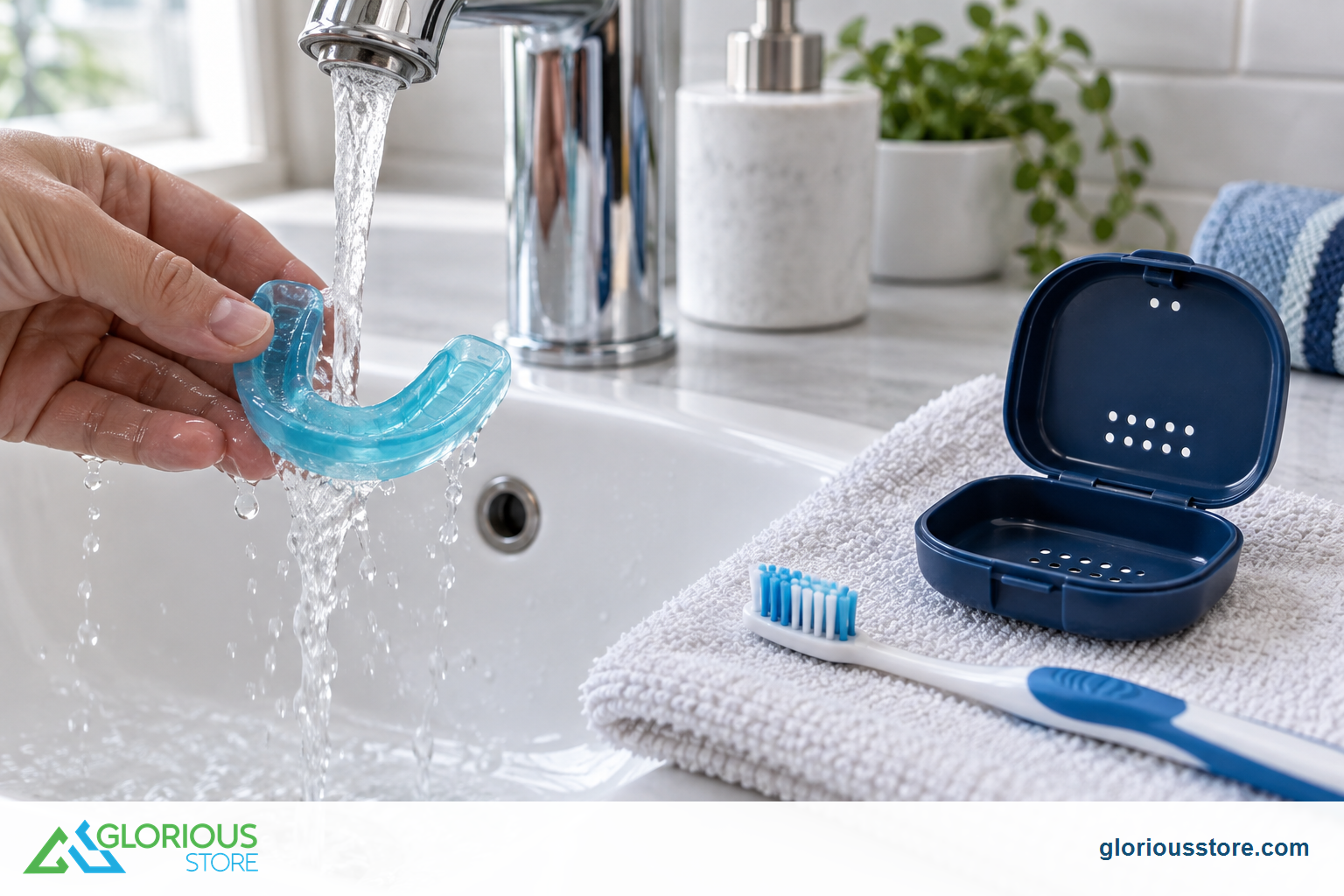
UAE heat makes storage discipline especially important. The ADA’s consumer guidance recommends rinsing before and after use, cleaning with a toothbrush and toothpaste or cool soapy water, rinsing thoroughly and storing the guard in a sturdy ventilated container. Keep it clean and dry between sessions.
Avoid leaving a mouthguard in direct sun, a hot car or hot water. Heat can change the shape that makes the fit useful. Do not share a mouthguard. Give it its own clean case, and keep the case out of a damp gym bag when you return home.
A simple routine is enough:
- rinse immediately after training;
- brush gently with a dedicated soft toothbrush;
- rinse away cleaner completely;
- let the guard and ventilated case dry;
- inspect under good light before packing it again;
- bring it to routine dental appointments when practical.
When should you replace it?
There is no responsible universal replacement date for every athlete. Replace a guard immediately if it is split, badly chewed, deformed, sharp, loose, painfully tight or otherwise ill fitting. Reassess after dental work, orthodontic adjustments or noticeable growth. Heavy users should inspect more often than occasional users.
Discoloration alone does not always reveal structural failure, and a guard can look tidy while fitting poorly. Condition and retention are better decision points than appearance alone. If you are unsure, have a dentist check it.
Buying checklist for UAE shoppers
Before purchasing, ask:
- Is the guard stock, mouth-formed or professionally custom-made?
- What exact age or size range does it cover?
- What material is used, and are any sensitivities relevant?
- Is it compatible with braces or other dental appliances?
- Are the molding instructions supplied and specific to this model?
- Does the sport, gym or competition require a particular design?
- Is a ventilated case included?
- Which color and size variant is actually available today?
For UAE delivery details, review the store’s shipping information. For sizing, contents or compatibility questions that the product page does not answer, contact Glorious Store before ordering.
Frequently asked questions
Do I need a mouthguard for every workout?
No. Need depends on the activity and its risk of impact to the teeth, lips, cheeks or jaw. Contact and collision sports are the clearest use cases. Ask your coach, governing body and dentist when the risk or rule is unclear.
Is a boil-and-bite guard the same as a custom dental guard?
No. A boil-and-bite guard is softened and shaped by the user according to its instructions. A custom guard is made for an individual mouth by a dental professional or laboratory.
Can a mouthguard be remolded?
Only if the manufacturer explicitly permits it. Reheating an unsuitable product can thin, distort or damage it. Follow the model-specific instructions rather than a generic online method.
Can I use a sports mouthguard as a night guard?
Do not assume so. Sports guards and night guards are designed for different purposes. Ask a dentist about grinding, clenching or sleep use.
What if I wear braces?
Ask your dentist or orthodontist for a guard that allows suitable protection and tooth movement. Remove retainers and other removable appliances for contact activity unless your dental professional gives different instructions.
Final take: choose the guard you can fit and wear correctly
The best sports mouthguard UAE shoppers can choose is not automatically the thickest, most expensive or most heavily advertised option. It is an appropriate design that fits securely, remains practical during the activity, is kept clean and is replaced when condition or fit changes.
Use Dubai Fitness Challenge as a prompt to build a safer routine, not as a reason to buy equipment you do not need. If boxing, martial arts or higher-risk training is part of your plan, compare the two current Glorious Fitness listings, confirm the missing fit details, and involve a dental professional when your teeth or treatment make the decision more complex.


Leave a comment