
The 2026/27 European club football season is now moving from opening week into a long run of matchdays. UEFA lists the Champions League league phase from September 8, 2026 through January 27, 2027, while Europa League Matchday 1 follows on September 16 and 17. That is a sensible moment to check a home satellite layout—but not to assume that one accessory can unlock any particular competition or channel.
For UAE homes, two small pieces of rooftop hardware are often confused: a four-port DiSEqC switch and a quad-output LNB. Both may show four connectors, but they solve opposite problems. A DiSEqC switch lets one compatible tuner select among several satellite feeds. A quad LNB lets several tuners use one satellite dish independently. Choosing the wrong one can leave a technically neat installation that cannot do the job you planned.
This DiSEqC switch vs quad LNB UAE guide explains the difference, the questions to ask an installer, and three current StarSat products checked on September 12, 2026. Channel availability, encryption and broadcast rights remain separate issues; use official, authorized services for subscription content.
The Short Answer
- Choose a DiSEqC switch when you have feeds from two, three or four satellite positions and want one receiver or TV tuner to select between them.
- Choose a quad LNB when one dish is aimed at one satellite position and you want up to four independent tuner feeds.
- You may need both in a larger design—for example, two satellite positions delivered independently to several rooms—but that usually requires multiple switches, one signal path per tuner, careful cable planning and professional configuration.
A passive TV splitter is not a safe substitute for either device. Satellite tuners send control voltage and tone or DiSEqC commands up the coaxial cable. Two tuners sharing a path can request different polarization or band states at the same time.
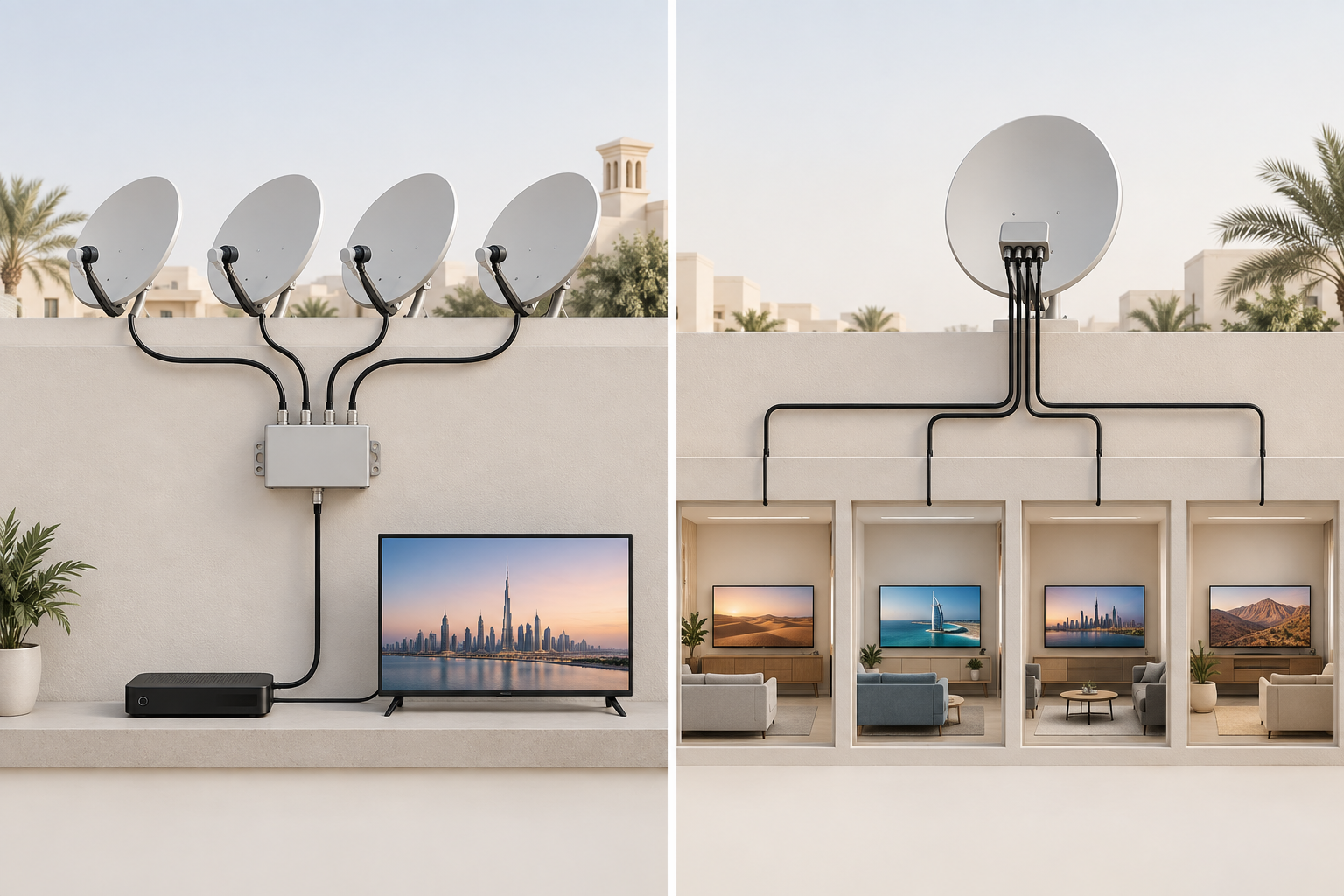
A DiSEqC switch consolidates several satellite feeds for one tuner; a quad LNB creates separate outputs from one satellite position.
What a DiSEqC Switch Actually Does
DiSEqC stands for Digital Satellite Equipment Control. Eutelsat describes it as a standardized communication bus between a satellite receiver and peripheral equipment over the existing coaxial cable. In a common home arrangement, the receiver sends a command and a switch connects the selected input to its output.
Picture three dishes or three LNB feeds aimed at different orbital positions. Their cables enter ports 1, 2 and 3 on a 4×1 switch. One output cable runs to the receiver. In the receiver’s antenna settings, each satellite must be assigned to the same physical port used on the roof. Select satellite A and the receiver asks the switch for port 1; select satellite B and it asks for port 2.
The switch selects one input path at a time. It does not aim dishes, create signal, decrypt services or guarantee reception; alignment, footprint, cabling, receiver support and authorized access still matter.
When a 4×1 DiSEqC switch fits
A four-port switch is a logical shortlist when all of these are true:
- You have two to four already aligned satellite feeds.
- One receiver or built-in satellite tuner needs to choose among them.
- The tuner supports the switch protocol and level stated by the accessory.
- Each satellite can be mapped to the correct port in the installation menu.
The current StarSat SR-X41S DiSEqC switch is listed as a 4×1, DiSEqC 2.0 accessory with 500 mA power passing and a published 950–2400 MHz range. Its live page showed 46 units in stock on September 12. The StarSat SR-X41M DiSEqC switch is another four-port option; its listing showed 49 units in stock and a 950–2150 MHz operating range.
Do not infer that one is automatically better from the model suffix. Confirm receiver support, product revision, frequency range and weather protection. Eutelsat also warns that “DiSEqC 2.3” is not a standardized level, so unfamiliar labels deserve manufacturer clarification.
What a Quad LNB Actually Does
An LNB sits at the focal point of a satellite dish and converts the received Ku-band signal into a lower-frequency signal that travels through coaxial cable. A quad LNB has four independent subscriber outputs. Eutelsat’s hardware glossary defines a quad LNB as an LNB providing four outputs simultaneously.
Those outputs are for separate tuner inputs: for example, a living-room receiver, a bedroom satellite TV and two other tuners. A two-tuner recorder may use two outputs so each tuner can request what it needs independently.
The current StarSat SL-4004 universal quad LNBF lists four independent outputs, a 10.70–12.75 GHz input range, 950–2150 MHz output, 9.75/10.60 GHz local oscillators, 0.6 dB noise figure and 60 dB gain. Its live page showed 8 units in stock on September 12. Because inventory is limited and specifications can change by revision, treat the product page as the final purchasing reference.
What a quad LNB does not do
A quad LNB does not select four different satellite positions. Its outputs all come from the satellite position seen by that dish. It also should not be confused with a quattro LNB: the names sound similar, but quattro outputs are normally fixed by band and polarization for use with a compatible multiswitch distribution system. Confirm the printed model and installer design before ordering.
DiSEqC Switch vs Quad LNB: A Direct Comparison
| Planning question | 4×1 DiSEqC switch | Quad LNB |
|---|---|---|
| Primary job | Select among multiple satellite feeds | Feed multiple tuners from one dish position |
| Typical inputs/outputs | Four LNB inputs, one receiver output | One dish feedhorn assembly, four subscriber outputs |
| Best fit | One tuner, several satellites | Several tuners, one satellite |
| Receiver setup | Map each satellite to a switch port | Set the correct LNB type for each tuner |
| Cable requirement | One output cable per switch/tuner path | One coax run per tuner input |
| Not a substitute for | Extra independent tuner feeds | Multi-satellite selection |
The phrase “four port” therefore means different things. Count the signal sources and tuner inputs, not just the sockets on the accessory.
Can You Use Both in One UAE Home?
Yes, but the system scales per tuner. For two satellite positions in two rooms, each satellite needs enough LNB outputs, each room needs its own switch and output cable, and both receivers need the correct port map. A passive splitter is different and can fail when tuners request conflicting states. Ask a qualified installer to design larger or communal systems.
A Pre-Installation Checklist
Before buying hardware or scanning channels, record the system on paper:
- List each satellite position you are legally and technically able to receive at the property.
- Count tuner inputs, not televisions. A twin-tuner recorder counts as two.
- Note the exact receiver or TV model and supported DiSEqC options.
- Match universal-LNB settings, local oscillator values and switch-port assignments to the equipment documentation.
- Plan one continuous, correctly terminated coax path for every independent tuner feed.
- Keep outdoor connectors dry, strain-relieved and sealed with suitable weatherproofing.
- Label both ends of every cable and each switch input before routing or closing enclosures.
- Test signal quality on each satellite and tuner before a full channel scan.
- Save or photograph the final port map for future troubleshooting.
- Recheck live stock and the exact revision before ordering.
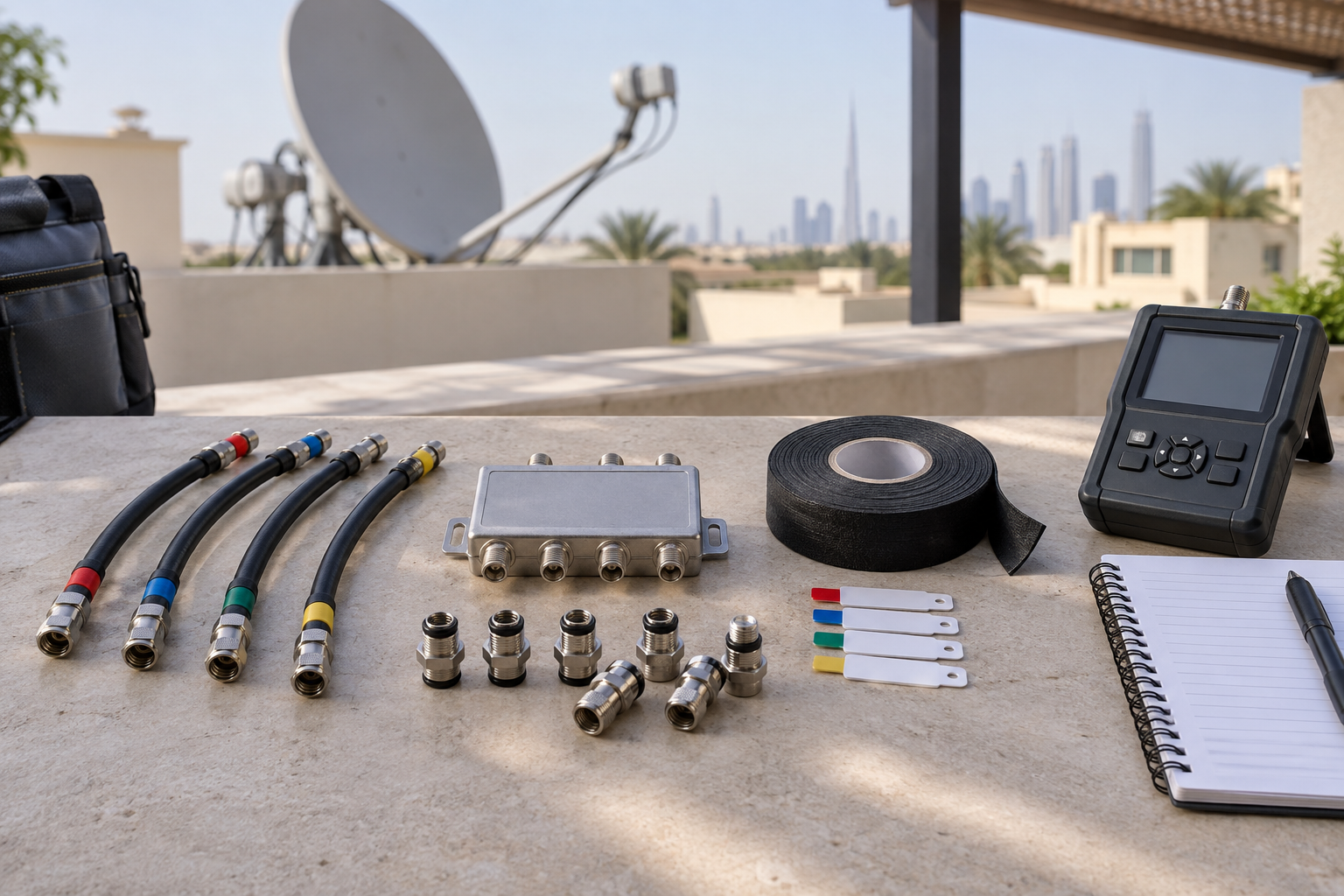
Label every feed before connection; a written port map is much faster to troubleshoot than an unmarked rooftop bundle.
In UAE heat and dust, connector condition matters. Loose F-connectors, water entry, sharply bent coax and exposed joints reduce reliability. Use a qualified installer where roof access or alignment is unsafe.
Five Setup Mistakes to Avoid
1. Buying a quad LNB for four satellites
Four outputs do not equal four orbital positions. A quad model serves four tuner feeds from one dish position.
2. Buying one DiSEqC switch for four rooms
A 4×1 switch selects inputs for one output path. Four independent rooms normally require four independent switch output paths or a properly designed multiswitch system.
3. Guessing the switch-port map
If the roof cable from one satellite enters port 2, the receiver must be configured accordingly. Wrong mapping often looks like missing channels or a failed scan.
4. Treating signal level as proof of correct alignment
A meter can show energy from the wrong satellite. Confirm the satellite identity and known transponders, then evaluate quality, not only a generic level bar.
5. Assuming hardware decides content rights
Reception equipment does not grant access to encrypted programming. UEFA’s calendar is the timely reason to review reliability; it is not a channel-availability claim. Check authorized broadcasters and subscription requirements for the country where you watch.
Frequently Asked Questions
Does a DiSEqC switch reduce picture quality?
A correctly specified switch passes the satellite intermediate-frequency signal within its published range. Poor connectors, excessive loss, unsuitable cable or damage can reduce the margin. Diagnose signal quality and errors, not image “sharpness” from the switch.
Can one quad LNB feed four TVs?
It can provide four independent outputs, but each TV needs a compatible built-in satellite tuner or an external receiver, a separate coax run, correct settings and access to the desired services. Count dual-tuner recorders separately.
Is DiSEqC 2.0 compatible with a receiver that lists DiSEqC 1.0?
Do not assume compatibility from the numbers alone. Check both manuals or ask the manufacturer or retailer about the exact models and functions you need before purchase.
Do I need a new channel scan after changing ports?
Usually the receiver must have the correct satellite-to-port mapping, and channels may need rescanning if the configuration or stored services changed. Back up a channel list first if the receiver supports it.
Which current product should I choose?
For one tuner selecting among several LNB feeds, compare the current SR-X41S and SR-X41M pages and confirm protocol and installation requirements. For several tuner feeds from one satellite position, the SL-4004 is the relevant type. If your design combines multiple satellites and rooms, ask for a complete system plan rather than ordering by connector count.
Plan the Signal Path Before You Order
Start with one sentence: “I need these satellite positions available to this many tuner inputs.” That immediately separates a DiSEqC selection problem from a multi-output LNB problem.
Review the current StarSat DiSEqC switch range and LNB range, or contact Glorious Store with the receiver model, satellite positions, tuner count and a simple cable sketch. For related checks, see the September satellite sun-outage guide and the UAE 4K satellite receiver guide.
Sources
- Eutelsat technical support: DiSEqC overview and standards notice, accessed September 12, 2026.
- Eutelsat devices and hardware glossary, accessed September 12, 2026.
- UEFA 2026/27 Champions League fixtures and results, updated September 9, 2026.
- UEFA 2026/27 Europa League dates, published August 28, 2026.
- Glorious Store SR-X41S, SR-X41M and SL-4004 live product pages, checked September 12, 2026.




Leave a comment